
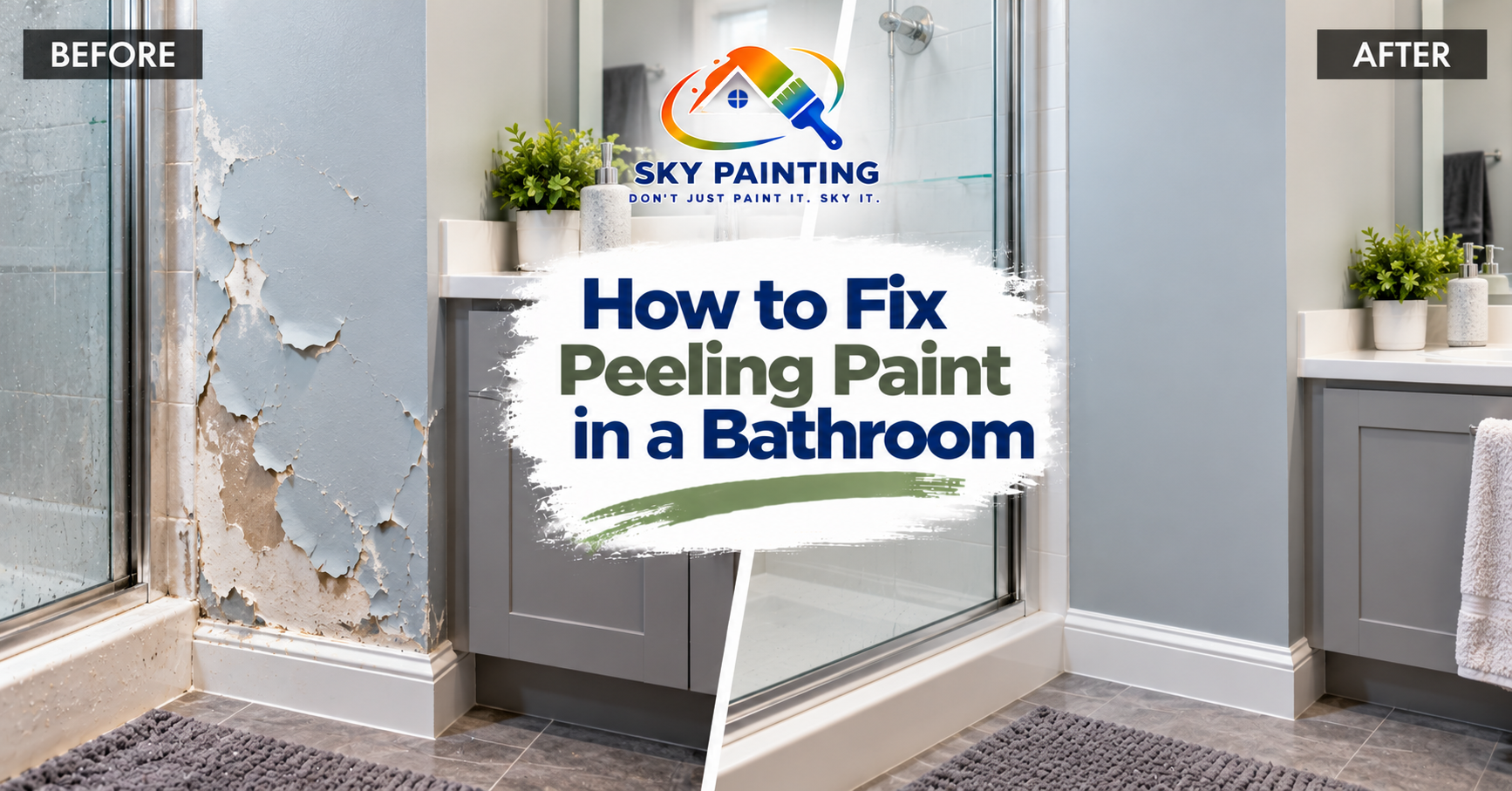
Peeling bathroom paint is one of the most common call-backs in Toronto homes. It's also one of the most predictable: if the paint peeled once, it will peel again unless you fix the underlying cause. Here's what causes it, how to fix it properly, and how to prevent it from happening after the next repaint.
Why bathroom paint peels
The root cause is almost always moisture. A hot shower generates steam that rises and condenses on the ceiling and upper walls. If that moisture has nowhere to go — because the exhaust fan is undersized, blocked, or vents into the attic rather than outside — it repeatedly soaks into the paint film. Over time, the moisture breaks the bond between the paint and the substrate, and the paint begins to lift.
Secondary causes include:
- Wrong paint product used — flat or matte paint in a bathroom holds moisture in the film and fails faster than satin or semi-gloss
- No primer before the finish coat — especially on drywall, skipping primer dramatically reduces adhesion
- Paint applied over existing peeling paint — the old failure continues underneath and the new coat peels with it
- Mold behind the wall surface — a more serious issue that requires remediation, not just repainting
How to fix peeling bathroom paint — the right way
Step 1: Fix the ventilation
Before any paint work begins, address the exhaust fan. A properly functioning bathroom fan in Toronto should move enough air to achieve at least one air change per minute in the bathroom volume. If your fan rattles, runs slowly, or you can't feel any draw when you hold a piece of tissue near it, it needs to be replaced or cleaned. Verify it exhausts to the exterior — not just into the ceiling cavity.
Step 2: Remove all peeling and loose paint
Scrape off all loose and peeling paint with a scraper. Don't just paint around the edges. This step is not optional — painting over loose paint always fails. Work until you reach a stable edge where paint is firmly adhered to the substrate.
Step 3: Address mold if present
Black spots under peeling paint are mold, not dirt. Treat with a diluted bleach solution (1 part bleach to 3 parts water), allow to dry fully, and then apply a mold-inhibiting primer before painting. If the mold is extensive or has penetrated the drywall, professional remediation is required before painting.
Step 4: Sand, prime, and paint correctly
Sand the edges of scraped areas smooth, apply a moisture-resistant primer to all repaired areas (and ideally the whole ceiling if it's been peeling), and then apply two coats of a bathroom-specific satin or semi-gloss paint.
The best paint products for Toronto bathrooms
- Benjamin Moore Aura Bath & Spa — matte finish designed specifically for high-humidity rooms; contains antimicrobial additives
- Sherwin-Williams Duration Home (satin) — durable, scrubbable, and holds up well in steam environments
- Benjamin Moore Regal Select (semi-gloss) — the workhorse semi-gloss for bathrooms; long-lasting and easy to clean
If your bathroom paint has been peeling repeatedly, it's worth having a professional assess the situation before repainting. Submit photos through our online quote form and we'll include the full scope — prep, repair, and finish — in a written estimate. See our bathroom painting service for more details.